How to Install Garbage Disposal in 5 Easy Steps

A Faster Kitchen Fix: What You Need to Know About Garbage Disposal Installation

Garbage disposal installation is a DIY-friendly project most homeowners can complete in 1 to 2 hours with basic tools — no plumber required.
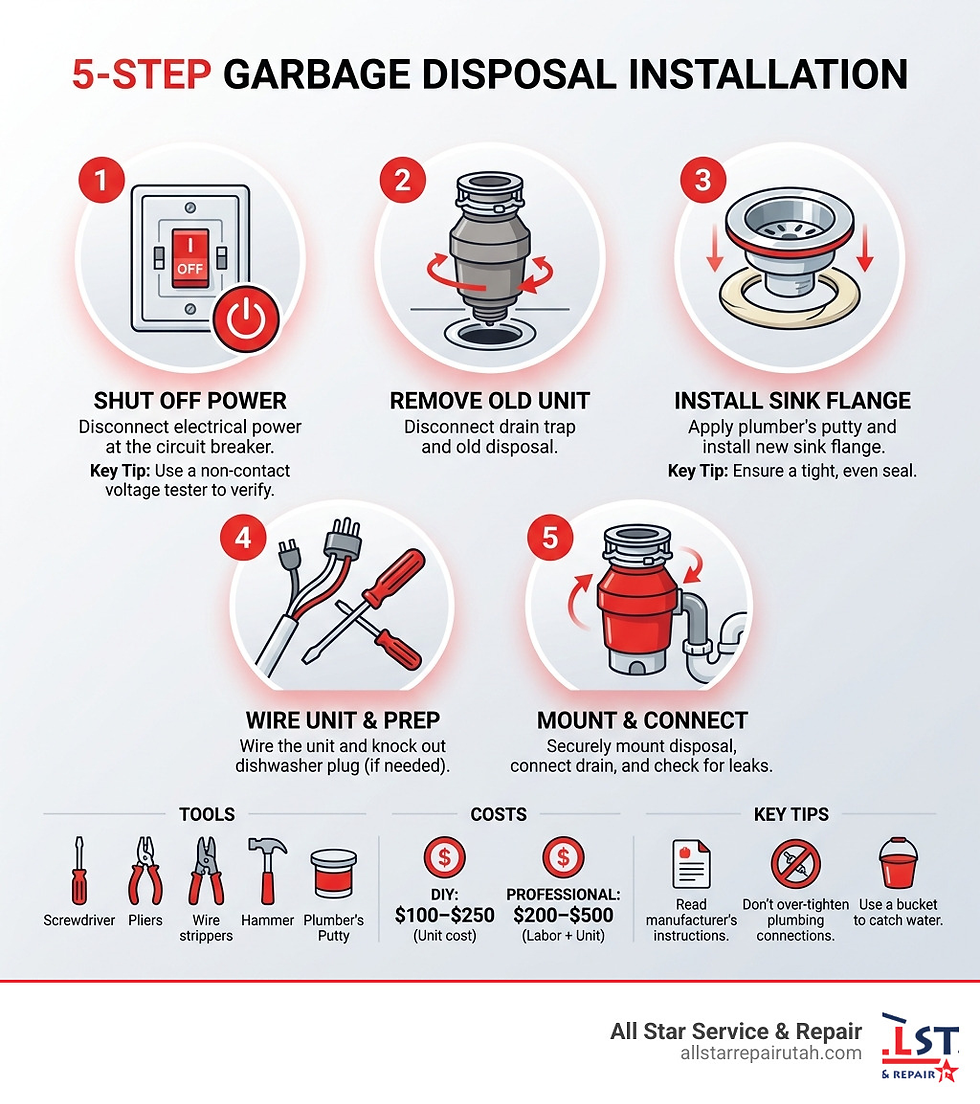
Here's the quick version of how it works:
Shut off power at the circuit breaker
Remove the old unit and disconnect the drain trap
Install the new sink flange with plumber's putty
Wire the unit and knock out the dishwasher plug (if needed)
Mount the disposal, connect the drain, and test for leaks
At a glance — what to expect:
DIY | Professional | |
Cost | $100–$250 total | $200–$500 labor + unit |
Time | 45–120 minutes | ~1 hour |
Tools needed | Basic hand tools | Provided by plumber |
Best for | Replacement installs | New wiring or drain work |
A failing garbage disposal is hard to ignore. It might start as a low hum after dinner, a slow drain, or a smell creeping out from under the sink. The good news? Swapping out an old unit — or putting in a new one — is one of the more approachable kitchen plumbing jobs you can tackle on a weekend.
That said, a rushed or incorrect installation can lead to leaks, electrical hazards, or a disposal that vibrates itself loose within weeks. The steps matter, and so does the order you do them in.
This guide from All Star Service & Repair walks you through the entire process — from picking the right unit to testing the final connection — so you can get it done right the first time.
Preparing for Your Garbage Disposal Installation
Before you dive under the sink and start unscrewing pipes, you need a game plan. Preparation is the difference between a 45-minute success story and a three-hour headache involving multiple trips to the hardware store in Provo.
When considering the financial side, How to Install a Garbage Disposal often comes down to a choice between time and money. While a professional installation ensures everything is up to code and leak-free, doing it yourself can save you anywhere from $200 to $500 in labor costs.
Tools and Materials List
To get the job done, gather these essentials:
Tools: Channel-lock (tongue-and-groove) pliers, a flathead and Phillips screwdriver, a hammer, a non-contact voltage tester, and a bucket to catch water.
Materials: Plumber's putty (about a 1/2-inch rope's worth), a power cord kit (if your new unit doesn't come with one), and wire nuts.
Choosing the Right Model for Your Garbage Disposal Installation
Not all disposals are created equal. When shopping for your new unit, keep these factors in mind:
Horsepower (HP): This is the engine of your disposal. A 1/3 HP model is strictly for light use (think small apartments). A 1/2 HP model is the standard for most households. If you have a large family or cook frequently, a 3/4 HP or 1 HP unit—like the Evergrind Garbage Disposer Product—provides the extra muscle needed to grind tougher scraps and prevent jams.
Continuous vs. Batch Feed: Continuous feed models run as long as the switch is on. Batch feed models only run when a special stopper is inserted, making them safer for homes with curious children.
Septic Safety: If your home in Northern Utah uses a septic system, look for "septic-safe" models that help break down food waste even further to protect your tank.
Safety Precautions for a Successful Garbage Disposal Installation
Safety isn't just a suggestion; it's a requirement.
Kill the Power: Locate your kitchen's circuit breaker and flip it to the "off" position. Use a non-contact voltage tester to verify there is no juice flowing to the unit.
Protect Your Eyes: Debris can fall when you're working under the sink. Wear safety glasses.
Check the Circuit: Modern codes usually require a dedicated 15-amp or 20-amp 120-volt circuit for the disposal to prevent tripping the breaker when you're also running the toaster or microwave.
Step 1: Removing the Old Unit and Preparing the Sink

If you are replacing an existing unit, the first step is getting the old "growler" out of the way.
Start by placing a bucket under the P-trap (that U-shaped pipe). Use your pliers to loosen the nuts and remove the trap. This is a great time to clean out any gunk hiding in the horizontal drain pipe. If you have a dishwasher connected, unscrew the hose clamp and pull the hose off the disposal's inlet.
To remove the disposal itself, you'll usually need to rotate the lower mounting ring counter-clockwise. These units are heavy—often 10 to 15 pounds—so use a second set of hands or prop a box underneath to catch it so it doesn't crush your fingers.
Once the unit is out, unscrew the three mounting screws on the old flange and pry off the snap ring with a flathead screwdriver. Push the old sink flange up through the sink hole. Now, the most important part: clean the sink opening. Scrape away every bit of old, crusty plumber's putty. A clean, dry surface is the only way to ensure your new garbage disposal installation doesn't leak.
Step 2: Installing the Sink Flange and Mounting Assembly

Now we start building. Take a golf-ball-sized piece of plumber's putty and roll it between your hands into a "snake" about 1/2 inch thick. Wrap this rope around the underside of the new sink flange.
Drop the flange into the sink drain hole and press down firmly. You want to see a little bit of putty "ooze" out—that’s the sign of a good seal! To keep the flange from popping up while you work underneath, place the new garbage disposal unit (wrapped in a towel to prevent scratches) on top of the flange to act as a weight.
Under the sink, slide on the fiber gasket, the backup flange, and the mounting ring. While holding these in place, snap the metal snap ring into the groove on the flange neck. This can be a bit of a finger-workout, so take your time. Finally, tighten the three mounting screws evenly. Don't crank one down all the way first; tighten them in a circle to ensure the pressure is balanced. Wipe away the excess putty that squeezed out into the sink.
Step 3: Wiring and Dishwasher Knockout Preparation
Before the disposal goes up, you need to handle the "insides."
The Dishwasher Knockout: If you have a dishwasher, this is the step everyone forgets. Inside the small inlet pipe on the side of the disposal, there is a plastic plug. Use a hammer and a screwdriver (or a punch) to tap it through. Crucial: Reach inside the disposal and pull that plastic "slug" out. If you leave it in, it will jam your new motor the second you turn it on! For more tips on keeping things running smoothly, check out our Garbage Disposal Smells Post.
Electrical Connections: Most disposals don't come with a cord. You’ll either need to "rob" the cord from your old unit or buy a new cord kit.
Remove the cover plate on the bottom of the disposal.
Thread the cord through the strain relief.
Connect the wires: Usually, black goes to black (hot), white goes to white (neutral), and the green wire goes to the green ground screw.
Secure them with wire nuts and wrap them in electrical tape for extra security.
Screw the cover plate back on.
Step 4 & 5: Mounting the Unit and Final Plumbing Connections
It's time for the heavy lifting. Lift the disposal and align the three mounting tabs with the ramps on the mounting ring. Turn the lower mounting ring clockwise until the tabs lock into place. You should hear or feel a "click" when it's fully seated. You can use a screwdriver as a lever in the mounting lugs to get that final, secure turn.
Next, connect the discharge tube (the pipe that comes with the unit) to the side of the disposal using the included gasket and flange. Align this tube with your P-trap. If the tube is too long, you can easily cut it to size with a hacksaw. Reconnect your P-trap and, if applicable, slide your dishwasher hose onto the inlet and secure it with a hose clamp.

Testing and Troubleshooting Common Installation Issues
Before you declare victory and put the cleaning supplies back under the sink, you must test for leaks.
The Static Test: Put the stopper in the sink, fill it with about 4 inches of water, and then pull the plug. Watch the connections under the sink with a flashlight.
The Power Test: Plug the unit in or flip the breaker. Turn on the cold water and flip the switch. Listen for any unusual vibrations.
Common Issues:
Leaking at the Flange: This usually means the mounting screws aren't tight enough or the plumber's putty didn't seal. Give the screws another half-turn.
Humming but No Spinning: You likely forgot to remove the dishwasher knockout slug, or a foreign object fell in during installation. Use an Allen wrench in the bottom of the unit to manually rotate the motor and clear the jam.
Vibration: Ensure the mounting ring is fully locked. If it's even slightly loose, the unit will shake like a leaf.
For more specialized help or to browse different models, visit our Garbage Disposals Category.
Frequently Asked Questions about Garbage Disposal Installation
Can I install a garbage disposal myself or should I hire a pro?
Most homeowners in Provo and across Northern Utah can handle a replacement installation. However, if you are installing a disposal where there wasn't one before—meaning you need to run new electrical wiring or significantly move your plumbing—it is safer to call the experts at All Star Service & Repair.
Are garbage disposal hookups universal across all brands?
Mostly, yes. Standard sink drains are 3-1/2 to 4 inches, and disposal outlets are 1-1/2 inches. However, different brands use different mounting systems (like the 3-bolt system vs. the EZ Mount). If you're switching brands, you will likely need to replace the sink flange to match the new unit.
What should I do if my disposal hums but doesn't spin after installation?
First, turn off the power! Check for a jam by using the "jam wrench" (Allen wrench) in the hole at the very bottom of the unit. If the motor is getting power but can't turn, it will hum. If it doesn't hum at all, try pressing the small red "reset" button on the bottom of the unit.
Conclusion
A successful garbage disposal installation makes kitchen cleanup a breeze and helps keep your home smelling fresh. By following these five steps—preparing your tools, removing the old unit, sealing the flange, wiring correctly, and securing the mounting—you can take pride in a job well done.
At All Star Service & Repair, we believe in integrity and transparency. We know that many residents in Provo and Northern Utah love a good DIY project, but we also know that plumbing can be unpredictable. If you run into a "slow leak nightmare," a wiring mystery, or simply want the peace of mind that comes with professional craftsmanship, we are here to help. Our team provides superior service with straightforward pricing, ensuring your kitchen is back in top shape in no time.
Ready to upgrade your kitchen? Explore our Garbage Disposal Services or give us a call today!


Comments