The Ultimate San Antonio Water Softener Repair Handbook

Updated: Oct 13
Why Northern Utah Homeowners Can't Afford to Ignore Water Softener Problems
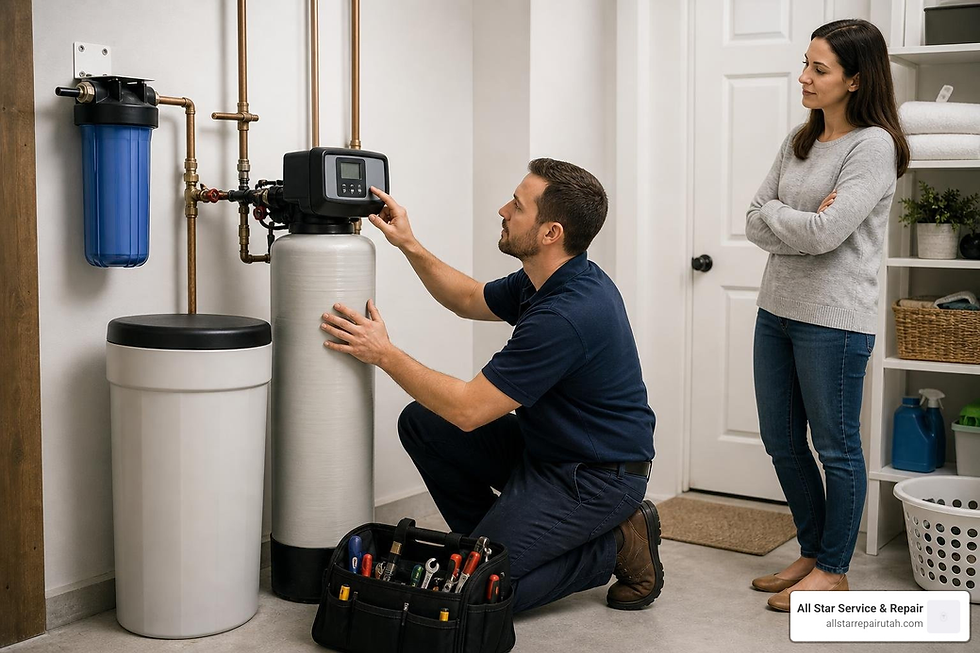
If you need water softener repair in Provo or Northern Utah, here's a quick summary of what you need to know:
Signs you need repair: Hard water returning, scale on faucets, spotty dishes, stiff laundry, salty taste, or unusual salt usage
Common repairs: Salt bridge removal, resin bed cleaning or replacement, control valve fix, brine tank cleaning
Repair cost: Most repairs run $100-$400 depending on the part and labor
Repair vs. replace: Repair if the unit is under 10 years old with an isolated issue; replace if it's older or breaking down repeatedly
How long repairs take: Most visits are completed in 1-2 hours
Service frequency: Annual maintenance is recommended for Utah homes with hard local water
Many homes along the Wasatch Front deal with hard water because groundwater and mountain runoff pick up calcium and magnesium as they move through local rock and soil. Those minerals put constant stress on your water softener, your pipes, and your appliances.
When a softener starts failing, the effects show up fast: white crust around faucets, soap that won't lather, dishes that come out cloudy, and laundry that feels rough to the touch.
Hard water affects over 85% of U.S. households and can increase cleaning product use, energy bills, and appliance wear.
The good news? Most water softener problems are fixable - and catching them early keeps repair costs low.
I'm Adam Wettach, owner of All Star Service & Repair. Our team proudly serves homeowners throughout Provo and Northern Utah, and we know how damaging hard water can be.
In this guide, I'll walk you through everything you need to diagnose, repair, or replace your system with confidence, specifically tailored for Utah's hard water conditions.

The Impact of Utah Hard Water on Local Homes
To understand why your water softener works so hard, it helps to understand what makes water hard in the first place. As the U.S. Geological Survey explains, water hardness is mainly caused by dissolved calcium and magnesium.
In Northern Utah, those minerals are common because water frequently passes through mineral-rich rock, soil, and groundwater formations before it reaches your home.
When this mineral-heavy water enters your home, it doesn't just stay in liquid form. As it is heated or pressurized, those dissolved minerals crystallize and form a rock-hard layer of scale.
This scale acts as a thermal insulator inside your water heater, forcing it to burn more energy just to heat your water.
In hard-water homes, scale can reduce your water heater's efficiency and shorten its lifespan significantly.
By contrast, a properly maintained Water Softener system prevents this scale from forming, helping protect your water heater, plumbing fixtures, and water-using appliances.
Over time, untreated hard water damages plumbing fixtures, clogs the internal valves of dishwashers and washing machines, and leaves your skin feeling dry and itchy.
For more details on how these systems protect your home plumbing, check out More info about water softener systems. In many Utah homes, water conditioning is a practical necessity, not a luxury.
Troubleshooting and Water Softener Repair in Northern Utah

When your water softener stops performing, it is easy to assume the worst. However, many common issues can be resolved with some straightforward troubleshooting before you decide to replace the entire unit.
Here are the most common issues we see in the field:
The Salt Bridge
This occurs when a hard crust forms over the salt in your brine tank, leaving an empty space underneath. The system appears full of salt, but the water cannot reach it to dissolve it during the regeneration cycle.
You can troubleshoot this by gently tapping the salt crust with a broom handle to break up the bridge.
Resin Degradation
Inside your softener's main tank are millions of tiny plastic resin beads. Over time - especially when exposed to municipal chlorine - these beads break down, turn mushy, and lose their ability to hold onto calcium and magnesium.
If you notice yellow or orange sand-like particles clogging your faucet aerators, your resin tank has ruptured or degraded.
Fluctuating Water Pressure
If you experience a sudden drop in water pressure across your entire home, your water softener's control valve or resin bed might be clogged. Flipping your bypass valve can help you determine if the softener is the bottleneck.
If you are unsure whether your system is salvageable, reading through this guide on Should You Repair or Replace Your Water Softener? can help clarify your options.
Common Indicators That Require Water Softener Repair in Northern Utah
If troubleshooting doesn't resolve the issue, you may need professional Water Softener Repair. Keep an eye out for these specific warning signs:
A Salty Taste in Your Water: If your tap water suddenly tastes like seawater, your system's regeneration cycle is failing to flush out the saltwater brine properly. This is usually caused by a clogged drain line or a malfunctioning control valve.
Water Leaks Around the Base: Any pooling water around the brine tank or resin tank indicates a cracked fitting, a worn-out O-ring, or a structural crack in the tank itself.
Motor or Timer Failure: If you don't hear your system regenerating at night, or if the control screen is blank, the motor or control board may have suffered an electrical short.
Clogged Venturi Nozzle: The venturi nozzle and injector create the suction needed to draw brine out of the salt tank. If this tiny nozzle gets clogged with sediment or salt crust, the regeneration cycle fails completely.
In Utah, it is also smart to watch for seasonal risks that can affect plumbing and softener performance. Take a look at Water Softener Repair Utah Winter Problems to Watch to understand how freezing temperatures can impact plumbing systems.
Choosing Between Replacement and Water Softener Repair in Northern Utah
How do you know when it is time to stop repairing your system and invest in a new one? We recommend using the "Rule of 10".
If your water softener is over 10 years old and the cost of the repair exceeds 50% of the cost of a new system, it is time for a Water Softener Replacement.
Older, single-tank systems often use outdated, timer-based regeneration cycles that waste salt and water. Upgrading to a modern, demand-initiated regeneration system can reduce your monthly salt costs.
If replacement is the smartest path forward, high-capacity models like the Sentry 48k Grain Water Softener Includes 1st Salt Fill Swap Out Only offer strong durability and high flow rates for homes dealing with hard water.
Professional Maintenance, Costs, and Local Plumbing Codes

Many homeowners ask what they should expect when hiring a professional for water softener services.
On average, a standard water softener installation in Northern Utah ranges from $800 to $2,500 depending on the size of your home, the plumbing layout, and the complexity of the system.
To help you weigh your options, we've put together a quick comparison table:
Factor | Water Softener Repair | Water Softener Replacement |
Average Cost | $100 - $400 | $800 - $2,500 |
Time Required | 1 - 2 Hours | 2 - 4 Hours |
Lifespan Added | 1 - 5 Years | 10 - 15+ Years |
Efficiency Impact | Restores original efficiency | Can reduce salt/water use with newer equipment |
Best For | Minor leaks, salt bridges, valve issues | Systems over 10 years old, cracked tanks |
What to Expect During a Professional Water Softener Tune-up
Regular preventative maintenance is the easiest way to reduce common plumbing issues caused by scale and mineral buildup. During a professional Water Softener Tune-ups visit, our technicians perform a comprehensive multi-point checkup.
This service includes a detailed Water Softener Inspection where we test your incoming and outgoing water hardness to verify the system is calibrating correctly.
We also clean the brine tank to remove accumulated salt mush, chemically flush the resin bed to restore its ion-exchange capacity, inspect all brine fittings for leaks, and reprogram the control board to match your current household water usage.
To learn more about keeping your system running smoothly year-round, explore our Water Softener Maintenance services.
Utah Plumbing Codes and Installation Timelines
If you are upgrading or installing a new system, it is crucial to ensure the work is done in compliance with state and local plumbing requirements.
Water softeners should be installed with proper cross-connection protection so brine water cannot backflow into your home's clean drinking water supply.
Additionally, the discharge line from your softener typically needs proper indirect drainage or an approved air gap before it enters a drain connection.
Requirements can vary by municipality, which is why we always recommend hiring a licensed plumber for your Water Softener Installation.
A professional installation typically takes between two to four hours and helps ensure your system is safely integrated, leak-free, and code-compliant.
How to Choose the Right Water Softener for Your Home
Selecting a water softener that fits your household's needs prevents premature system failure and keeps your utility bills low.
When shopping for a system, keep these three factors in mind:
Grain Capacity
This measures how many grains of water hardness the system can remove before it needs to regenerate.
To calculate your household's daily grain capacity requirements, multiply the number of people in your home by 80 gallons, which is a common estimate for daily water use per person, and then multiply that number by your tested water hardness level.
Salt-Based vs. Salt-Free
Salt-based systems use true ion exchange to replace calcium and magnesium ions with sodium or potassium. This is the only method that physically removes hard minerals from the water.
Salt-free systems are actually water "conditioners." They alter the physical structure of the minerals to reduce how readily they stick to pipes, but they do not soften the water or remove the minerals.
Single-Tank vs. Multi-Stage Systems
Traditional systems feature a separate brine tank and resin tank. However, modern single-tank systems combine filtration, softening, and polishing into one space-saving footprint.
High-quality single-tank systems are designed to handle heavy mineral hardness and, when properly configured, additional water quality concerns such as chlorine.
Frequently Asked Questions About Utah Water Treatment
How often should a water softener be serviced in Northern Utah?
Because many Utah homes deal with hard water, we recommend having your water softener professionally serviced at least once a year. Homes with large families or high water usage may require bi-annual inspections to ensure the resin bed isn't fouling prematurely.
For a detailed breakdown of local service recommendations, refer to our Northern Utah Water Softener Repair Guide.
Can I repair a water softener control board or bypass valve myself?
While homeowners can easily handle basic tasks like breaking up salt bridges, complex components like the Water Softener Control Board or the Bypass Valve Water Softener should be repaired by a licensed plumber.
Miswiring a control board can ruin the electronics, and an improperly repaired bypass valve can lead to significant water damage in your home.
How long do water softeners typically last in Utah?
On average, a high-quality water softener lasts 10 to 15 years. However, homes with very hard water, high water use, or elevated chlorine levels may see resin beads degrade sooner.
Regularly flushing your resin bed and installing a pre-filter where appropriate can help extend your system's lifespan.
Conclusion
Living with hard water in Provo and Northern Utah doesn't have to be a daily struggle.
By keeping an eye out for early warning signs - like spotty dishes, white crust on your fixtures, or a sudden drop in water pressure - you can address minor issues before they turn into expensive plumbing emergencies.
Whether you need a quick valve repair, a routine maintenance tune-up, or a brand-new high-efficiency installation, choosing an experienced local team ensures the job is done right.
All Star Service & Repair serves homeowners in Provo and throughout Northern Utah with the integrity, transparency, straightforward pricing, and superior service our customers expect.
Ready to protect your plumbing and appliances from the harsh effects of hard water?


Comments